
Wedding dress preservation is one of the most important decisions a bride makes after the wedding — and one of the least understood.
Most brides know they should do it. Far fewer know what it actually involves, why it matters beyond keeping the dress pretty, and what happens to a gown that skips it.
Here is a clear, honest explanation of the entire process and why each stage exists.
The simple definition
Wedding dress preservation is a two-part professional service: cleaning followed by archival storage. The cleaning removes every stain — visible and invisible — from the gown after the wedding.
The archival storage packages the cleaned gown in acid-free materials designed to prevent yellowing, fabric deterioration, and mildew across decades of storage.
The critical distinction from standard cleaning is the storage component. A gown that is professionally cleaned but then placed in a regular garment bag or a standard cardboard box begins deteriorating again almost immediately.
The cleaning removes internal threats — stains and organic residue already in the fabric. Archival storage removes external threats — the acidic compounds, moisture, and light exposure that cause damage over time. Both are necessary.
Neither alone is preservation. Preserving what wedding dress preservation means as a complete process — not just cleaning, not just storage — is the foundation of every decision that follows.
Invisible stains are the real enemy
The stains every bride worries about — the wine spill, the grass mark at the hem, the champagne splash on the skirt — are actually the most manageable.
A specialist identifies them immediately, pre-treats them individually, and removes them during the cleaning process. The stains that cause the most long-term damage are the ones nobody sees on the wedding day.
Perspiration absorbed into the bodice lining throughout eight or ten hours of wear. Body oils transferred to every fabric section that came into contact with skin.
Sugar compounds from champagne and white wine that dried clear on the fabric surface. Floral dye from the bouquet contacts the waist and cuffs. None of these is visible when the dress comes off at the end of the night.
All of them begin oxidizing in the fabric immediately — turning white and ivory fabric yellow or brown over the following weeks, months, and years.
A bride who looks at her dress the morning after the wedding and thinks it looks clean is seeing the surface. What is happening inside the fabric fibers is invisible — and it is already in progress.
This is why the two-week post-wedding window matters so much. Should you clean your dress after the wedding within that window gives every invisible compound the best chance of full professional removal before the oxidation process advances.
Waiting months — or years — means those compounds have been actively breaking down the fabric throughout the delay.
Preservation process
Understanding each stage of the process helps brides evaluate any service accurately and ask the right questions before entrusting an irreplaceable garment to anyone.
Here is what genuine professional preservation involves from start to finish:
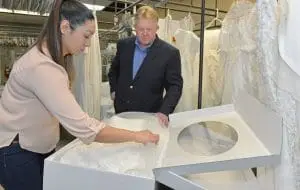
- Individual inspection — the gown is examined under proper lighting before any treatment begins; every visible stain is mapped, invisible staining locations identified, fabric composition confirmed section by section, and embellishment security checked
- Pre-treatment — each stain area is treated individually with chemistry appropriate to that specific stain type and that specific fabric; a perspiration stain on silk requires different treatment from a grass mark on polyester
- Cleaning — the full gown is processed using fabric-safe methods appropriate to its composition; silk, satin, lace, and synthetic blends each handled according to their individual requirements
- Drying — controlled drying prevents watermarking on satin and silk; rushed drying creates visible surface marks that pressing cannot fully address
- Pressing — the gown is pressed layer by layer to restore its original silhouette and remove compression marks from the wedding day and cleaning process
- Final inspection — every section reviewed against the original stain map to confirm all areas have been addressed before the bride is shown the result
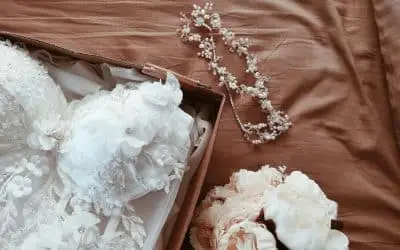
- Archival boxing — the pressed gown is wrapped in acid-free, lignin-free tissue paper at every fold point and sealed in an archival-quality preservation chest that protects the fabric from acid migration, moisture, light, and pest access
The chemistry behind the box
Standard cardboard boxes, regular tissue paper, and plastic garment bags all contain lignin and acidic compounds that migrate into stored fabric over time.
This is not a slow, harmless process — acid migration begins within months and accelerates with every year the gown remains in contact with non-archival materials. The result is the yellowing along fold lines and contact points that brides discover when they open a box they believed was protective.
Genuine archival materials are acid-free and lignin-free throughout their entire construction — not simply coated white on a standard cardboard core.
The box’s internal structure, the tissue paper inside it, and the bust form supporting the bodice all need to meet archival standards. Any single non-archival component that touches the fabric is a source of contamination, regardless of what surrounds it.
Acid-free wedding dress storage using museum-grade materials is what the archival boxing component of preservation actually provides — and it is what separates a preservation service from simply returning a clean gown in a decorative box.
The materials used in the boxing stage determine how long the preservation result actually lasts.
Who needs preservation
Preservation is not the right choice for every bride in every situation. Understanding who benefits most helps brides make an informed decision rather than assuming it is either always necessary or never worth the cost.
Preservation is the right choice for brides who:
- Plan to keep the dress as a family heirloom and hope to pass it to a future generation
- Want to protect the option to sell the dress at the best possible price — a preserved gown sells faster and at a higher value than an untreated one
- Are you keeping the dress for a daughter or niece who may want to wear it
- Plan to repurpose the dress and want to keep every option open until a decision is made
- Simply want to store the dress safely without monitoring it constantly
Preservation is less critical — though still beneficial — for brides who plan to sell or donate the dress within the next few months and simply need it cleaned and presentable. Even in this case, professional cleaning within two weeks of the wedding produces a noticeably better resale result than a dress left untreated.
Whether wedding dress preservation is worth it as an investment is answered most clearly by the alternative: a gown stored without preservation that requires costly restoration years later, or that deteriorates beyond restoration entirely. The cost of preservation is minimal compared to either outcome.
What happens without preservation?
A gown, cleaned but stored without archival materials, begins to yellow at every contact point within months. By year two or three, fold lines are visibly discoloured. By year five, general yellowing is often significant.
By a decade, the gown may require professional restoration to be wearable again — at greater cost and with less certainty of full result than the original preservation would have required.
A gown not cleaned before storage carries invisible stains that cause permanent damage, regardless of how good the storage materials are.
Brown patches from oxidized perspiration and champagne compounds surface on their own timeline — often appearing as dramatic discoloration years after the wedding with no obvious cause.
Not cleaning your wedding dress before storage is the single decision that undermines every other preservation effort. Wedding dress preservation costs are modest compared to the restoration costs they prevent and genuinely minimal compared to what most brides spend on the gown itself.
Chicago Wedding Dress Cleaners handles the complete preservation process in-house across Chicagoland — individual inspection, fabric-specific cleaning, pressing, and archival boxing — with free pickup and delivery so the gown never has to be transported at risk.
Every gown is handled personally by the owners, with the bride’s approval confirmed before sealing.
Quick tip: Book your preservation pickup before the wedding — not after. The post-wedding period moves fast, and having the pickup scheduled in advance ensures the gown reaches a specialist within the critical two-week window regardless of how busy the honeymoon and post-wedding schedule turns out to be.
Helpful guidance:
These articles support every stage of the preservation journey:
- Best way to preserve your wedding dress
- How long does a preserved wedding dress last
- Wedding dress preservation kit
Expert advice worth reading:
For a thorough breakdown of what professional wedding dress preservation involves — including what archival materials actually do at a chemical level and how to evaluate any service before trusting them with your gown — this complete preservation guide from The Knot covers every stage with honest expert input from preservation specialists.
FAQs
What is the difference between cleaning and preservation?
Cleaning removes stains and organic residue from the fabric after the wedding. Preservation goes further — after cleaning, the gown is wrapped in acid-free tissue and boxed in archival-quality materials that prevent yellowing, mildew, and fabric deterioration across decades of storage.
How soon after the wedding should preservation be arranged?
Within two weeks is the critical window. Invisible stains from perspiration, champagne, and body oils begin oxidizing immediately after the wedding — the sooner they are professionally removed, the better the result and the less aggressive the treatment required.
Does preservation guarantee the dress will never yellow?
A reputable preservation service backed by a 100-year anti-yellowing guarantee provides the strongest available assurance — but the guarantee is only as meaningful as the company behind it.
Can a dress be preserved if it was not cleaned immediately after the wedding?
Yes — preservation can be arranged even years after the wedding. The longer the delay, the more challenging some stains become to fully remove, but professional cleaning and archival boxing still significantly improve the gown’s condition and protect it going forward.
Is preservation worth it for a dress I plan to sell?
Absolutely. A professionally preserved gown sells significantly faster and at a noticeably higher price than an untreated one on any resale platform.
What fabrics are most important to preserve professionally?
Silk and vintage lace require the most specialist care and benefit most significantly from professional preservation rather than any home approach.
Can accessories like the veil and gloves be preserved alongside the gown?
Yes — veils, gloves, sashes, and other fabric accessories can be cleaned and preserved alongside the gown.
What does an archival preservation box actually do?
It creates a chemically stable environment around the gown that prevents acid migration, moisture, or pest access to the fabric.
Should I open the preservation box after it is sealed?
Annual inspection is recommended — the box should be opened carefully every one to two years to check the gown’s condition, replace compressed tissue with fresh acid-free sheets, and refold along slightly different lines to prevent permanent crease marks.
What is the difference between a preservation box and a vacuum-sealed container?
A breathable archival preservation box allows gentle air exchange while protecting from external threats. A vacuum-sealed or airtight container traps any moisture present and prevents the humidity regulation required for archival fabric storage.
How much does professional wedding dress preservation cost in Chicago?
Standard cleaning and preservation at Chicago Wedding Dress Cleaners typically ranges from $200 to $400, depending on the gown’s complexity, fabric type, and the extent of staining.
Does Chicago Wedding Dress Cleaners handle the complete preservation process in-house?
Yes — every stage, from individual inspection through cleaning, pressing, and archival boxing, is handled in-house by the owners.