
A vintage wedding dress pulled from decades of storage does not always reveal immediately what it needs — or whether it can be saved at all.
Most can. Some cannot. The difference comes down to a handful of specific signs anyone can check before spending a dollar on professional help.
Here is exactly what to look for and what each sign means.
The fabric test
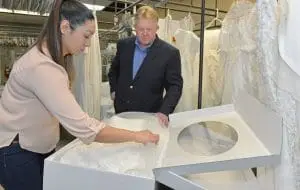
Lay the gown flat on a clean white surface and touch the fabric very gently between two fingers. What you feel tells you more than what you see.
Fabric that still moves naturally and has some flexibility means the fibers are healthy. Yellowing and staining are surface problems — treatable with professional restoration in almost every case.
Fabric that feels slightly stiff after decades in storage is also not a red flag on its own; professional cleaning often restores suppleness to fabric that simply dried out in storage.
What should concern you is fabric that feels crispy, papery, or crunchy under gentle pressure. This indicates fiber breakdown has begun.
If the fabric sheds particles or leaves residue on your fingers when touched, active deterioration is occurring — and it needs a specialist assessment immediately, before any further handling causes additional damage.
Silk is the most vulnerable fabric in this test. Its natural protein structure degrades faster than cotton, polyester, or synthetic blends — which is why gowns from the 1950s and 1960s present different challenges than those from the 1970s and 1980s.
Understanding how wedding gown fabrics have changed over the decades provides useful context for what your specific gown might need.
What the smell tells you
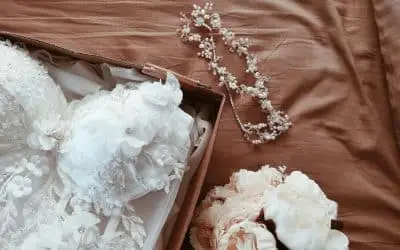
Open the box and note the odor before touching anything. A faint, stale smell is completely normal after years in storage and will clear with professional treatment. The character of the smell matters far more than its presence.
A deep, musty, or sour smell is a warning. It indicates moisture entered the storage environment at some point, creating conditions for mildew.
Mildew does not just stain fabric — it actively breaks down organic fibers from within. If you smell mildew, close the box and contact a professional immediately without further handling.
A sharp chemical smell — reminiscent of plastic — typically means the gown was sealed in a plastic bag for an extended period. Plastic off-gassing compounds that react with fabric and accelerate yellowing significantly.
This does not mean the gown is unsaveable, but it does mean the fiber damage needs professional assessment before any treatment begins. Acid-free storage exists precisely because of what plastic and regular cardboard do to fabric chemistry over the years.
Reading the yellowing honestly
Almost every vintage gown has some yellowing, and yellowing alone is not a reason to give up on a dress. Restoring a yellowed wedding dress is achievable in the vast majority of cases. The question is what type of yellowing you are dealing with.
General surface yellowing — a warm ivory tone across the fabric — is the most treatable form.
Cotton and polyester whiten most fully. Silk brightens significantly but may not return to pure white after decades of oxidation.
Irregular brown or orange patches under the arms, along the hem, or across the bodice are a different matter. These are oxidized stains from the original wedding day — perspiration, body oils, and champagne sugars that were never cleaned out before storage.
They respond to specialist pre-treatment, but results depend on how deep the oxidation has penetrated and how long it has been developing.
A specialist assesses each stain area individually before any treatment begins — no honest restorer promises full removal without seeing the gown in person.
Checking lace, seams, and embellishments
Work through the gown methodically after the fabric and color check:
- Lace edges — run a fingertip very gently along lace borders without applying pressure; fraying is repairable, but lace that crumbles at the slightest touch needs immediate stabilization by a specialist
- Seams — press gently along major seams at the bodice, waist, and hem; seams that give easily or show thread deterioration need reinforcing before any alteration work begins
- Beading and embellishments — loose beads, detached appliqués, and missing sequins are all repairable; their extent shapes the repair time and cost, but not the fundamental restorability of the gown
- Lining condition — the internal lining often deteriorates faster than the outer fabric; a yellowed or separated lining needs replacing, but this does not affect whether the gown can be saved
Storage history matters as much as age
Where a gown lived for the last twenty or forty years shapes the restoration challenge as much as its age.
A 60-year-old gown stored in a climate-stable interior room in a breathable bag often presents an easier restoration than a 30-year-old gown sealed in plastic in an attic.
Chicago’s seasonal extremes — summer heat and winter cold — make attic and basement storage particularly damaging. Fabric expands and contracts with temperature changes, weakening fibers over time at fold lines and seam stress points.
Knowing how to store a wedding dress correctly makes it clear why climate-stable interior storage is not optional for a gown intended to survive generations.
A gown genuinely cannot be fully saved
A reputable specialist will tell you this honestly — and will tell you before taking payment. The clearest signs a gown may be beyond full restoration:
- Fabric that actively disintegrates to the touch, leaving fibers on your fingers with minimal handling
- Fabric rot along fold lines where the weave has broken down entirely
- Significant mould damage that has penetrated deep into the fabric fibers
- Very fine vintage silk sections that have become rigid and dissolve in water — a known issue with certain mid-century silk types
Even in these cases, partial salvage is almost always possible. Original lace panels, buttons, embroidered sections, and decorative trims can be preserved and turned into a lasting keepsake — so the most meaningful parts of the gown live on even when the full garment cannot be worn.
Helpful Guidance:
These articles support every stage from assessment through to storage:
- Heirloom gown preservation in Chicago
- Best way to preserve your wedding dress
- Store a wedding dress for two or more years
Expert Guidance:
For a thorough guide to vintage wedding dress care — including what professional restoration involves and how to evaluate a gown’s condition — this complete preservation guide from The Knot covers every fabric type with honest expert input.
FAQs
Is a heavily yellowed vintage dress still salvageable?
In most cases, yes. Yellowing alone is rarely a barrier to restoration. Cotton and polyester whiten most fully.
What does crispy or papery fabric mean?
It indicates fiber breakdown has begun. Minor stiffness from storage is normal and often reversible.
Can a gown stored in plastic for decades be restored?
Often yes. Plastic storage accelerates yellowing and causes chemical reactions in the fabric, but the extent of damage depends on storage duration, temperature, and fabric type.
What does a musty smell indicate?
It means moisture entered the storage environment, creating conditions conducive to mildew growth. Surface mildew can sometimes be treated professionally.
Does age alone determine whether a gown can be saved?
No. Storage conditions matter more than age. A well-stored 70-year-old cotton gown often presents a far easier restoration than a 30-year-old silk gown that spent decades sealed in plastic in a Chicago attic.
Should I try cleaning at home before getting a professional assessment?
Never. Even gentle home treatments on vintage fabric carry a real risk of irreversible damage.
How does Chicago Wedding Dress Cleaners handle vintage gown assessments?
Every gown is assessed in full before any work begins. Fabric type, stain composition, structural integrity, and embellishment condition are all evaluated individually.