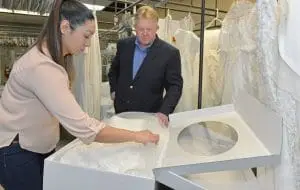

Chicago brides who have done the research consistently come to the same conclusion — a local specialist who handles every gown personally delivers results that national chains and off-site facilities simply cannot replicate.
This is not sentiment. It is a practical reality rooted in how chain operations process gowns versus how a dedicated local specialist treats them.
Here is exactly why that difference matters and what it means for your dress.
The chain model
Most brides who hand a wedding dress to a chain cleaning operation assume it is being treated on-site by someone who knows what they are doing. In the majority of cases, that assumption is wrong.
Many chain operations send bridal gowns off-site to wholesale facilities that process dozens — sometimes over thirty — gowns simultaneously in large-batch machines. Individual stain pre-treatment is minimal.
Gown-specific fabric assessment rarely happens. And because the finished gown arrives back sealed in a box, there is often no way to confirm the cleaning actually addressed the specific stains that were present.
What wedding dress cleaners actually do when they handle gowns correctly — individual inspection, stain mapping, fabric-specific pre-treatment — does not happen inside a batch processing model.
In-house specialist cleaning
Chicago Wedding Dress Cleaners has handled every gown in-house, personally, with the owners involved in each job for over 35 years. No gowns are sent to off-site facilities. No batch processing.
Every dress that arrives — whether a modern polyester satin gown from a 2024 wedding or a silk heirloom from the 1960s — receives a full individual assessment before any treatment begins.
What does that assessment cover
- Every stain identified and mapped under proper lighting — visible and invisible
- Fabric composition confirmed across every section of the gown
- Embellishment security is checked before any moisture or treatment touches the dress
- Structural integrity is assessed, so any weak seams are stabilized before cleaning begins
- A full discussion with the bride about specific concerns and priorities before work starts
This is the foundation of every cleaning decision. A stain pre-treatment chosen without this information is guesswork — and guesswork on a $2,000 silk gown is not acceptable.
How cleaners handle delicate fabrics correctly is built entirely on this kind of individual assessment — there is no responsible shortcut.
The fabric knowledge gap between chains and specialists
A national chain operation is designed to process volume. Bridal fabric — silk, duchess satin, French lace, vintage organza, delicate tulle — requires knowledge that volume processing cannot accommodate.
The cleaning agent that works perfectly on polyester satin causes permanent watermarking on silk. The temperature that safely presses duchess satin scorches vintage chiffon.
The agitation of a modern synthetic gown destroys the weave structure of fragile vintage lace.
Chicago brides with silk gowns, vintage heirloom pieces, or heavily embellished designer dresses choose local specialists precisely because this fabric knowledge is the difference between a restored gown and an irreversibly damaged one.
Restoring a yellowed wedding dress on a 40-year-old silk gown is not a service a chain can reliably deliver — it requires the kind of hands-on, fabric-specific expertise that only comes from decades of individual gown work.
Here is what sets a specialist’s fabric knowledge apart from a chain’s approach:
- Silk handling — hand-processed with pH-neutral agents, never agitated in machines, pressed only with a cloth barrier
- Vintage lace — individually supported throughout cleaning, never placed under mechanical tension
- Beading and embellishments — assessed before cleaning; those vulnerable to moisture or heat are removed and treated separately
- Duchess satin — processed with awareness that sizing is removed during cleaning, with the bride informed in advance
- Polyester and synthetic blends — correctly identified, so appropriate methods are used rather than defaulting to the most aggressive available cycle
Accountability
When something goes wrong at a national chain — a stain remains, a fabric is damaged, a seam fails during cleaning — the accountability structure is diffuse.
The gown may have been processed off-site by a wholesale facility the bride never spoke to. The counter staff who took it in were not involved in the cleaning.
The response is often a complaint process, a refund policy, or a dispute between parties, each with limited visibility into what actually happened to the dress.
A local specialist operates differently. The person who assessed your gown, decided how to clean it, and processed it is available — directly, by name, by phone — if there are any questions or concerns.
Chicago Wedding Dress Cleaners communicates throughout the cleaning process. Before and after documentation is standard. No work begins without the bride’s agreement on the plan and the expected outcome.
Is wedding dress preservation worth it? It is a question that answers itself when the alternative is to send an irreplaceable gown to a facility where nobody knows what it contains and nobody is accountable if something goes wrong.
The free pickup and delivery advantage
One of the most overlooked risks in wedding dress care is transport.
A gown folded into a bag for a car journey, crammed into a back seat, or — worse — shipped through a postal service picks up compression damage, potential staining from contact with packaging materials, and the risk of loss or transit damage before it ever reaches a cleaner.
Chicago Wedding Dress Cleaners eliminates this entirely. Free pickup and delivery across Chicagoland, Northwest Indiana, and Southeast Wisconsin means the gown stays flat, supported, and properly handled from the moment the team arrives at the bride’s door.
This is a genuine practical advantage over any service requiring transport — local or otherwise.
For North Shore brides in Lake Forest, Highland Park, or Evanston, for DuPage County brides in Wheaton, Naperville, or Downers Grove, and for brides across Cook County, the gown never has to leave the house until it is ready.
Cleaning your dress after the wedding within the first two weeks is the most important post-wedding step — and free pickup removes the single most common reason brides delay.
35 years of Chicago knowledge
A local specialist who has served Chicago brides for over three decades understands what the city’s wedding season actually does to bridal gowns. Summer weddings at the Chicago Botanic Garden in Glencoe mean grass and floral dye on hemlines.
Lake Michigan lakefront ceremonies mean wind damage to veils and fabric. Chicago’s humid summers mean perspiration staining that sets faster than in drier climates.
Gold Coast hotel receptions mean champagne and food contact across multiple fabric types throughout a long evening.
This contextual knowledge shapes how a local specialist approaches cleaning in ways that a national chain — operating from a standardised playbook across dozens of cities — simply cannot.
Wedding dress cleaning for a gown worn at an outdoor North Shore venue in August requires a different pre-treatment approach than one worn at a winter hotel wedding in December.
A local specialist who has cleaned thousands of Chicago-area gowns knows this instinctively. A chain processing facility does not.
Quick tip: Before trusting any cleaning service with your gown, ask one question — do you clean the gown in-house or send it off-site? If the answer is off-site, your dress is going to a batch processing facility where individual attention is impossible. In-house, owner-involved cleaning is the only model that gives a bridal gown the treatment it actually needs.
Helpful guidance:
These articles help Chicago brides make confident decisions about post-wedding gown care:
- Should you clean your dress after the wedding? Why professional cleaning within two weeks is the most important post-wedding step
- Professional wedding dress cleaner — what a specialist does that a standard garment service cannot
- Wedding dress cleaning cost — understanding what specialist cleaning costs and why the price reflects real expertise
Expert advice worth reading:
For an honest comparison of wedding dress cleaning options — including what to ask any service before handing over a gown — this complete wedding dress care guide from Brides covers every cleaning and preservation option with specialist input from across the industry.
FAQs
Do chain cleaners actually clean wedding dresses on-site?
Many do not. A significant number of chain operations send bridal gowns to off-site wholesale facilities for processing.
What is the risk of batch processing for wedding gowns?
When gowns are processed in large batches, individual pre-treatment of specific stain areas is minimal or absent.
How does a local specialist approach stain treatment differently?
Every stain is identified individually during assessment and pre-treated with the appropriate agent for that specific stain type and fabric before the main cleaning begins.
Is a local specialist more expensive than a chain?
Not necessarily — and even when the price is comparable, the value is not. A local specialist is providing individual assessment, fabric-specific treatment, in-house processing, and personal accountability that chains do not.
Why is free pickup and delivery important for gown safety?
Transport is one of the most common sources of additional damage to a wedding dress.
Does Chicago Wedding Dress Cleaners clean gowns in-house?
Yes — every gown is cleaned in-house by the owners personally. No gowns are sent to off-site facilities. No batch processing.
How soon after the wedding should I contact a local specialist?
Within two weeks of the wedding — ideally sooner. Invisible stains from champagne, body oils, and floral contact begin oxidizing immediately and become significantly harder to remove the longer they sit untreated in the fabric.