
Choosing the right storage boxes for your wedding dress is not a minor detail — it is the decision that determines whether your gown survives decades in storage or emerges yellowed, brittle, and damaged beyond repair.
The difference between acid-free and regular storage boxes comes down to chemistry, and understanding that chemistry is the most practical thing a bride can do after her wedding day.
Regular boxes
Standard cardboard boxes, regular tissue paper, and plastic containers all contain acids and lignin compounds, naturally present in wood pulp that break down over time and release into whatever is stored inside them.
This is not a slow, harmless process.
Acid migration from a regular cardboard box into delicate bridal fabric begins within months and accelerates with every year the gown stays inside.
The effects are predictable and consistent. White and ivory fabrics yellow at every fold line and point of contact with the box walls.
Silk fibers weaken at a molecular level, becoming brittle and prone to tearing under minimal handling. Lace loses its flexibility and begins to crumble at the edges. Embellishments tarnish or discolor where the acidic environment contacts metal or adhesive components.
A gown that looked clean and intact when placed in a regular box will not look the same when it comes out — and the damage is almost always irreversible by the time it becomes visible.
Plastic is no better. Sealed plastic traps moisture against the fabric, creating the conditions for mildew and accelerating the same yellowing process through a different chemical pathway.
Plastic off-gasses compounds that react directly with fabric fibers, which is why gowns stored in plastic garment bags for years consistently arrive for restoration more severely yellowed than those stored in breathable materials.
How to store your wedding dress correctly starts with understanding exactly this — the container is not a neutral element in long-term fabric health.
What acid-free actually means
Acid-free does not simply mean “not acidic right now.” Genuinely archival-quality acid-free materials are manufactured without lignin, without acidic compounds, and with a pH of 7 or above — meaning they are chemically stable and will not release damaging compounds into the fabric over time.
What to confirm before:
- The box is lignin-free throughout — not just acid-free coated on the outside with a standard cardboard core inside. If the internal flutes or structural layers are brown, the box is not fully acid-free and will eventually migrate acid through the white coating into the fabric
- The tissue paper used inside is acid-free and lignin-free — regular tissue paper, including most gift-wrapping tissue, contains acids that transfer directly to fabric at every fold and contact point
- The bust form or internal structure keeping the bodice shaped is also acid-free — any non-acid-free component touching the fabric is a contamination source, regardless of what the box itself is made from
Acid-free wedding dress storage using genuinely archival materials is the single most effective preventive measure available after professional cleaning — and it is the standard Chicago Wedding Dress Cleaners applies to every preservation boxing service.
Chicago’s climate
Chicago’s humid summers and cold winters create storage challenges that brides in more temperate climates do not face to the same degree.
Humidity levels above 60% — common in Chicagoland during July and August — encourage mildew growth in any storage environment that is not properly protected.
Temperature fluctuations between summer and winter cause fabric fibers to expand and contract repeatedly, weakening seams and embellishments over time at every point of stress.
A regular cardboard box in a Chicago attic or basement is one of the worst possible storage environments for a wedding dress. The box introduces its own acid migration.
An acid-free archival box does not solve every environmental problem — it cannot control the temperature of the room it sits in. But it eliminates the box itself as a source of damage, which is the most controllable factor in the entire storage equation.
Storing a wedding dress for two or more years safely in a Chicago home requires the right box in the right location — both matter, and neither alone is sufficient.
The tissue paper question
Many brides focus entirely on the box and overlook the tissue paper inside it — but every fold in the gown that is not cushioned with acid-free tissue is a potential crease point and a potential contact point for acid migration.
Regular tissue paper contains the same lignin and acidic compounds as regular cardboard. White gift tissue paper looks identical to acid-free tissue paper but behaves completely differently inside a storage box over the years.
Here is what acid-free tissue paper does at every fold:
- Cushions the fabric so compression creases do not become permanent fault lines in the structure
- Prevents fabric surfaces from pressing directly against each other, which causes abrasion damage and color transfer between fabric layers over time
- Creates a chemical buffer between the gown and any fold point — absorbing rather than contributing acidity
- Fills the bodice and skirt structure to maintain the gown’s original silhouette during long-term flat storage
Keeping your wedding dress white for generations is a commitment that runs from the cleaning through to the tissue paper used at every single fold.
Cleaning before boxing
An acid-free box does important protective work — but it cannot undo damage already present in the fabric when the gown was inside.
A dress boxed without professional cleaning carries invisible stains that continue to oxidize in the archival environment.
Champagne, body oils, perspiration, and floral contact from the wedding day continue to react with the fabric fibers, regardless of what surrounds them on the outside.
This is the correct sequence — always: professional cleaning first, acid-free preservation boxing second.
Should you clean your dress before storing it explains exactly why this order is non-negotiable — the box protects the fabric from external threats, but only professional cleaning removes the internal threats already present in the fabric from the wedding day itself.
Chicago Wedding Dress Cleaners cleans every gown individually before preservation boxing. The acid-free materials used meet archival standards — lignin-free throughout, not simply coated.
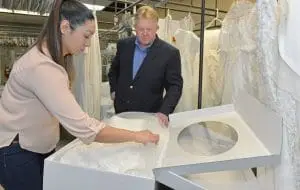
The gown is wrapped with acid-free tissue at every fold point, boxed in a breathable archival container, and returned ready for long-term storage. Free pickup and delivery across Chicagoland means the gown never has to be transported at risk before or after this process.
Wedding dress preservation cost reflects genuine archival-quality materials and in-house specialist care — not the cheapest box available from a supplier.
Helpful Guidance:
These articles cover every aspect of long-term wedding dress storage:
- Best way to preserve your wedding dress
- Wedding dress preservation kit
- Store your wedding dress in a loft
Further Information:
For a thorough breakdown of what acid-free storage actually involves — including the museum-conservation standards applied to archival textile storage and how they translate to wedding dress preservation — this complete preservation guide from The Knot covers every material and storage scenario with expert input from preservation specialists.
FAQs
Why does regular cardboard yellow a wedding dress?
Regular cardboard contains lignin and acidic compounds from the wood pulp used to make it.
Is plastic storage better than regular cardboard for a wedding dress?
No — plastic is equally damaging through a different mechanism. Sealed plastic traps moisture against the fabric, creating conditions for mildew, and off-gases compounds that react directly with fabric fibers.
What is the difference between acid-free and pH-neutral boxes?
Acid-free archival boxes are manufactured without acids or lignin throughout their entire construction.
Does the tissue paper inside the box matter as much as the box itself?
Yes — equally. Every fold in the gown that is not cushioned with acid-free tissue is a direct point of contact between the fabric and a potentially acidic surface.
How long can a gown be safely stored in an acid-free archival box?
When professionally cleaned before boxing and stored in an acid-free archival box in a climate-stable interior room, a wedding dress can remain in excellent condition for 30 years or more.
Should the acid-free box be sealed airtight?
No — museum conservators specifically recommend against airtight sealing. Fabric needs gentle air exchange to maintain stable humidity around the garment.
How often should the gown be checked inside the preservation box?
Every one to two years is the general recommendation. Check for yellowing, moisture, pest activity, or any change in fabric condition.
Can I reuse the acid-free box if I need to re-preserve the gown?
The box itself can be reused if it remains structurally sound and undamaged by moisture or pests.
Does the size of the preservation box affect how well it protects the gown?
Yes. A box that is too small forces the gown into tighter folds, creating more compression points where permanent crease lines can develop over time.
What happens if moisture gets inside an acid-free preservation box?
Even inside an archival box, moisture creates conditions for mildew growth and fabric deterioration.
Is a viewing window on a preservation box safe for the gown?
Only if the window is made from UV-coated polyester film rather than standard plastic.