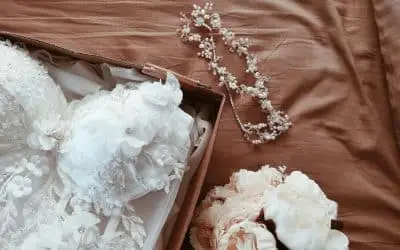

Knowing your fabric before your gown reaches a specialist makes the entire professional cleaning process smoother, faster, and safer.
Silk and satin look similar on a hanger and feel luxurious in the hand — but they are fundamentally different materials that require completely different cleaning approaches.
Getting that distinction wrong causes permanent damage. Here is what every bride needs to understand before her gown goes anywhere near a cleaning service.
Silk and satin are not the same thing
This surprises many brides. Satin is not a fiber — it is a weave pattern. It can be made from silk, polyester, nylon, or acetate.
Silk, on the other hand, is a natural protein fiber produced by silkworms.
True silk has a soft, warm sheen and a slightly nubby texture. Satin — particularly polyester satin — has a cooler, brighter, more reflective surface that feels ultra-smooth to the touch.
Why does this matter for cleaning? Because the fiber content, not just the surface appearance, determines how the fabric responds to moisture, heat, cleaning agents, and agitation.
A polyester satin gown and a silk gown can look almost identical on a rail but require entirely different treatment during cleaning. Applying the wrong process to either one causes irreversible damage — shrinkage, watermarking, loss of shine, or fiber breakdown.
What professional wedding dress cleaners actually do before touching any gown includes precisely this kind of fabric identification — it is the foundation of every cleaning decision that follows.
Silk is the most demanding fabric to clean
Silk is a protein-based fiber, which makes it both extraordinarily beautiful and extraordinarily sensitive. Water alone — in the wrong temperature or applied with too much pressure — causes permanent spotting on silk satin.
The wrong pH in a cleaning agent weakens silk fibers irreversibly. High heat causes silk to yellow and become brittle.
Water spotting on silk
This is the most common and most frustrating issue in cleaning silk gowns. A single water droplet landing on silk satin and drying there leaves a visible ring mark that is extremely difficult to remove.
This is why even minor home treatment attempts on silk — dabbing at a stain with a damp cloth — so frequently cause more visible damage than the original stain.
Sugar stains and silk
Sugar-based stains from champagne, wine, and fruit juice present a particular challenge on silk.
These stains are invisible when dry — they appear to have cleaned up or disappeared — but the sugar compounds remain in the fabric fibers and caramelize over months, turning brown or yellow without warning.
A silk gown that looks perfectly clean when put into storage can emerge months later with brown patches across the bodice and skirt.
Not cleaning your wedding dress after the wedding and storing it untreated is particularly damaging for silk — the sugar compounds left in the fabric from the reception continue reacting with the fibers throughout storage.
Specialists approach silk cleaning
A professional who understands silk fabric uses pH-neutral cleaning agents, minimal mechanical agitation, carefully controlled moisture exposure, and hand processing throughout. The gown is never placed in a machine.
Each stained section is pre-treated individually with agents suited to the specific stain type.
How satin cleaning differs
Satin’s cleaning requirements depend almost entirely on what it’s made of. Polyester satin — the most common type in modern bridal gowns — is significantly more forgiving than silk satin.
It tolerates more moisture, responds well to gentle wet processing, and whitens more fully with brightening treatment than silk does. It is also less prone to watermarking and handles pressing more predictably.
Polyester satin
Polyester satin is the most straightforward bridal fabric to have professionally cleaned. It tolerates gentle wet cleaning well, responds predictably to stain pre-treatment, and can be pressed safely using appropriate temperature settings.
Synthetic satin gowns from contemporary designers are almost always polyester — they look stunning but cost significantly less to produce and care for than their silk counterparts.
Wedding dress cleaning for a modern polyester satin gown in good condition is typically a more straightforward process than for silk or vintage fabric.
Silk, satin, and duchess satin
These are the most demanding types of satin. Silk satin combines the weave structure of satin with the protein fiber sensitivity of silk — meaning it has the high-gloss surface of satin alongside the watermarking vulnerability of silk.
Duchess satin — a heavy, crisp silk fabric commonly used in structured ball gowns — adds another layer of complexity because its body comes partly from sizing added during production.
Acetate satin
Acetate is a semi-synthetic fabric that feels similar to silk but behaves very differently under moisture.
Acetate satin shrinks in water and is extremely sensitive to high heat. Many vintage bridal gowns from the 1950s through 1970s used acetate satin, which is why professional assessment of vintage gowns before any cleaning begins is non-negotiable.
How to wash vintage clothes correctly varies by decade and fabric type — the same decade-specific knowledge applies to vintage bridal fabric.
The comparison at a glance
| Silk | Polyester Satin | Silk Satin / Duchess | |
|---|---|---|---|
| Water sensitivity | Very high | Low | High |
| Watermark risk | High | Low | High |
| Yellowing risk | High | Low-moderate | High |
| Heat tolerance | Low | Moderate | Low |
| Cleaning complexity | Most complex | Straightforward | Complex |
| Home treatment risk | Very high | Moderate | Very high |
Quick tip: Check your dress label before contacting any cleaning service. If it says “100% silk” or “silk satin,” make sure the specialist specifically confirms experience with silk bridal fabric — not just bridal gowns generally. The difference in expertise matters enormously for the result.
Helpful guidance:
These articles cover fabric-specific care for bridal gowns in detail:
Expert advice worth reading:
For a complete guide to how different wedding gown fabrics affect cleaning and preservation — including silk, satin, lace, and tulle — this expert bridal fabric care guide from Brides covers every material with specialist input from bridal care experts across the industry.
FAQs
How do I know if my wedding dress is silk or satin?
Check the care label — it lists the fabric composition. “100% silk” confirms silk. “Polyester,” “nylon,” or “acetate” confirms that it is a synthetic satin.
Can I spot clean a silk wedding dress at home?
Only with extreme caution. Dabbing a damp cloth on silk causes watermarking — the moisture creates a visible ring around the treated area that is harder to remove than the original stain.
Is polyester satin easier and cheaper to clean than silk?
Yes — on both counts. Polyester satin tolerates more moisture and a wider range of cleaning agents than silk, making the process less time-intensive and reducing the risk of complications during treatment.
Does satin watermark like silk does?
Polyester satin is relatively resistant to watermarking. Silk, satin, and duchess satin are susceptible, particularly to steam applied directly to the surface without a pressing cloth.
How long does cleaning a silk gown take compared to a satin one?
Silk gowns typically take longer because hand processing at every stage requires more time than machine-assisted treatment.
Should the gown be pressed differently depending on whether it is silk or satin?
Yes. Polyester satin tolerates more heat during pressing than silk. Silk must always be pressed with a clean pressing cloth between the iron and the fabric, and ideally while still very slightly damp to prevent crease lines from setting permanently.